MOTZ'S
DRIVER
SIGNUP.
Scaling onboarding for 40k+ truckers by making identity, vehicle, and compliance validation faster, clearer, and less dependent on support.
01 — The Problem
Scaling driver onboarding without scaling support.
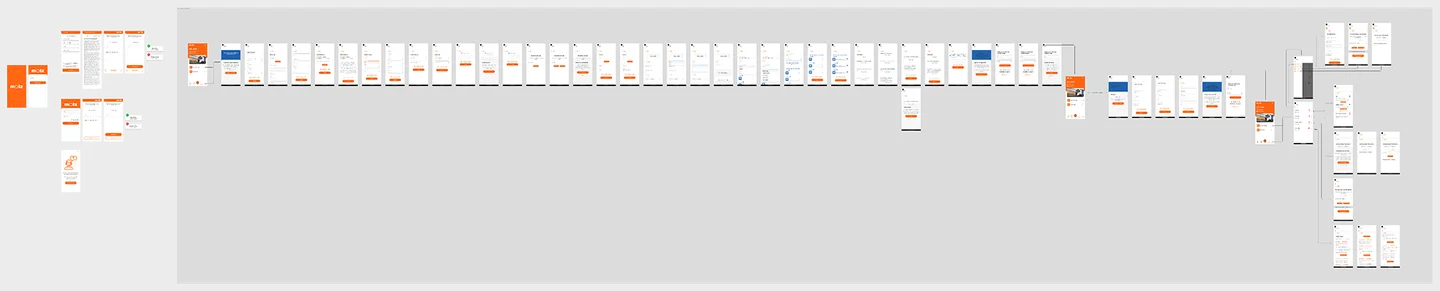
Legacy Flow — A complex, multi-step sequence with high drop-off risks
Motz Transportes, a logistics venture spun off from Votorantim Cimentos, tasked our team with migrating and onboarding over 40k drivers onto a native platform. The primary barrier was architectural: a legacy enterprise framework encumbered by high mental effort, redundant data inputs and an absence of self-service workflows.
The Operational Bottleneck: Onboarding required continuous manual intervention from operations. High-friction data entry (RENAVAM inputs, complex vehicle licensing metrics, physical documentation uploads) caused cascading input validation errors. These errors turned simple formatting errors into high-volume support tickets and regulatory compliance issues.
ANTT compliance maintained (data integrity validated).
PII protected via SAP compliance; KMM TMS sync working in production.
Discovery: The Hidden Friction
The UX team conducted contextual inquiries with Motz customer operations, audited KMM integration data, and mapping-analyzed over 500 failed conversion funnels. The diagnostic patterns pointed directly to structural input fatigue.
The Quantitative Evidence
Stakeholder and benchmark Insights
Stakeholder and benchmark Insights
Progressive Onboarding: Deferring structural profiling by capturing entry-level operational data first, unlocking advanced vehicle configuration steps asynchronously as value is delivered.
Rodrigo Cumim, CCO General Manager
Automated Data Capture: Deploying Optical Character Recognition (OCR) microservices to extract credentials directly from physical licenses, reducing manual input errors.
Sidney Palmeiro, Corporate Projects Department
Recurrent Compliance: Accounting for mandatory 6-month credential re-validation cycles inherited from legacy regulatory policies.
Brenda Kelly, head of operations for southeastern Brazil.
The Problem Statement.
"Manual user inputs generated the core operational friction. Unvalidated input errors directly triggered critical customer support spikes and severe compliance vulnerabilities across both Motz and Votorantim systems."
Competitive Benchmarking
Main Objectives
Deconstruct Onboarding Mechanics
Evaluated five direct and indirect competitors in the logistics ecosystem, mapping interaction friction, form architectures, and pattern strengths to identify scalable recruitment baselines.
Process Optimization
Translate market design insights into a streamlined onboarding strategy, ensuring full architectural alignment with enterprise backend frameworks.
Cognitive Load Reduction
Simplify information architecture specifically for field constraints, decreasing time-to-onboard and overall user input fatigue.
Secondary Objectives
Database Sync Strategy
Research structural patterns to maintain synchronous data state across platforms, completely eliminating entity duplication.
Technical Capability Audit
Assess the integration complexity of async OCR engines, state-saving mechanics, and rapid validation systems.
Out of Scope
Macro Logistics Strategies
Long-term operational growth or business positioning metrics unrelated to transactional onboarding interfaces.
Non-Driver Features
Freight matching, financial payout ledgers, and tactical route management features are excluded from this optimization cycle.
| Feature |
 TMOV
TMOV
|
 FreteBras
|
 Freto
Freto
|
 Strada
|
 kan.guru
|
 Motz (Old)
|
|---|---|---|---|---|---|---|
| Pre-fill vehicle data | ||||||
| Resume registration | ||||||
| Step-by-step guidance | ||||||
| Instructions w/ ANTT | ||||||
| Immediate approval |
Strategic Gap: Market intelligence revealed a distinct design opportunity. Competitors consistently deployed either step-by-step guidance or data pre-fills, but never integrated both patterns simultaneously. Combining these approaches allowed Motz to define the industry benchmark.
02 — Strategic Frameworks
Product principles for a safer onboarding flow
Before committing to technical delivery, we formulated five operational principles to benchmark all cross-functional engineering and design cycles. This architecture guaranteed that aesthetic refinement remained aligned with strict transactional performance.
An entry interface is inherently throttled by its backend origin. Transforming rigid regulatory constraints (synchronous ANTT validation) into a frictionless, automated competitive advantage.
Downtime directly impacts freight margins. Deploying robust offline states and asynchronous queues allowed drivers to progress uninterrupted through high-latency API bottlenecks.
Eliminating operational clarity gaps directly compresses error-correction cycles. Reducing administrative touchpoints translated into immediate, transparent ROI for customer operations.
Scaling a platform for over 40k drivers introduces massive operational variance. Proactive error mapping and validation rules neutralized processing vulnerabilities prior to full release.
Designing efficient logtech solutions requires deep operational immersion into tax frameworks, government compliance protocols, and distributed legacy infrastructure.
Deconstructing Ecosystem Integrations
To optimize onboarding conversion, we audited the multi-platform enterprise ecosystem inherited from Votorantim. This deep dive mapped data-flows across KMM's Transport Management System (TMS), Trizy's logistics scheduling engine, core SAP ledgers, and ANTT's registration databases to resolve hidden system friction points.



03 — Strategic Decision 1: Bureau Integration
Automating the source of truth
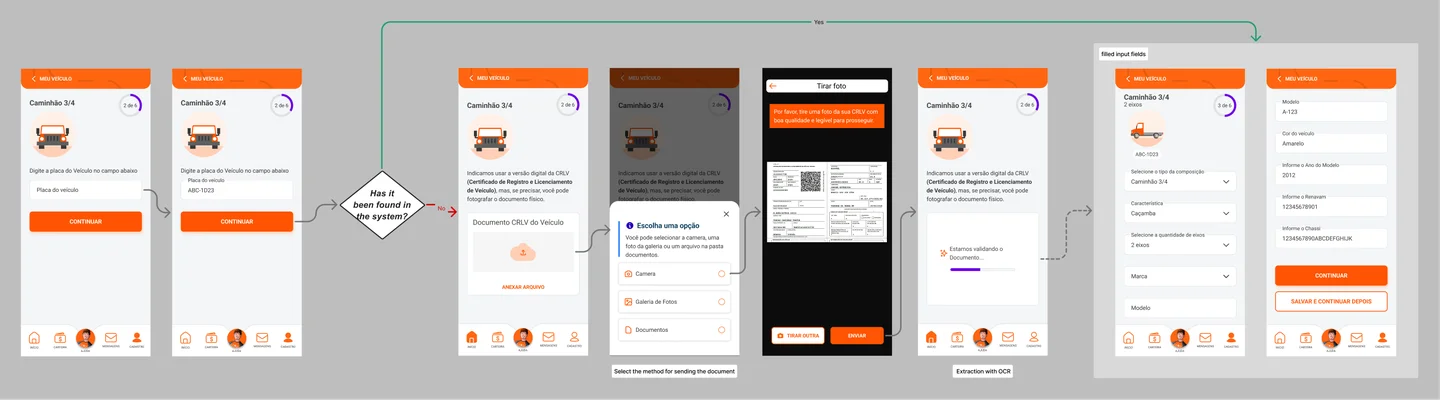
Bureau Integration — Real-time vehicle validation via license plate
Strategic Decision: Automate vehicle and driver profiling through a centralized data bureau integration, utilizing the license plate as the unique identifier for asynchronous query resolution.
Problem Solved: Truckers were previously forced to manually input complex RENAVAM sequences on mobile devices, generating massive typo overhead. Integrating external data bureaus eliminated this interface friction by dynamically auto-populating RENAVAM records, chassis specs, and legal ownership details in real-time.
Result: Complete elimination of manual ingestion errors, drastically reducing customer support ticket generation rates during onboarding.
Production Validation: Real-time state synchronization successfully neutralized cross-system data duplication between Motz and Votorantim enterprise infrastructures.
04 — Strategic Decision 2: OCR
OCR-driven document validation
 r.webp)
OCR Validation — Real-time extraction of document data
Strategic Decision: Implement an Optical Character Recognition (OCR) pipeline to extract driver license (CNH) and vehicle registration (CRLV) data automatically during the document upload lifecycle.
In-Field Validation: Contextual usability testing conducted at the Osasco Distribution Center (CD Osasco) demonstrated an 85%+ initial parsing baseline. Automating this step completely removed manual document transcription, dropping decision friction under real-world warehouse conditions.
Result: Compressed time-to-task completion for the document validation phase from ~5 minutes down to ~1 minute.
Production Telemetry: Post-launch production monitoring confirmed a 95%+ parsing accuracy index across an initial cohort of 500+ unguided, real-world document submissions.
05 — Strategic Decision 3: UX Writing
Clear language and progressive disclosure
Strategic Decision: Restructure the transactional interface using strict progressive disclosure principles combined with localized, plain-language engineering to align with the driver's mental model.
Cognitive Load Optimization: The legacy system exposed over 30 input fields simultaneously, inducing immediate form abandonment. We modularized the journey into four asynchronous, logical phases: Identity Baseline → Bureau-Populated Vehicle Specs → OCR Document Validation → Financial Payout Setup. Technical labels were replaced with clear, contextual language that drivers could understand at a glance.
Result: Systemic onboarding lifecycle duration compressed by 30% across all audited cohorts.
Production Validation: Operational data confirmed a substantial expansion in end-to-end conversion throughput prior to general platform release.
- RENAVAM ► Vehicle Registration (Automated Bureau Fetch)
- CNH ► Driver's License Number (OCR Extracted)
- Specify Tractor Chassis Variant ► Select Your Vehicle Type
06 — Strategic Decision 4: Support Enablement
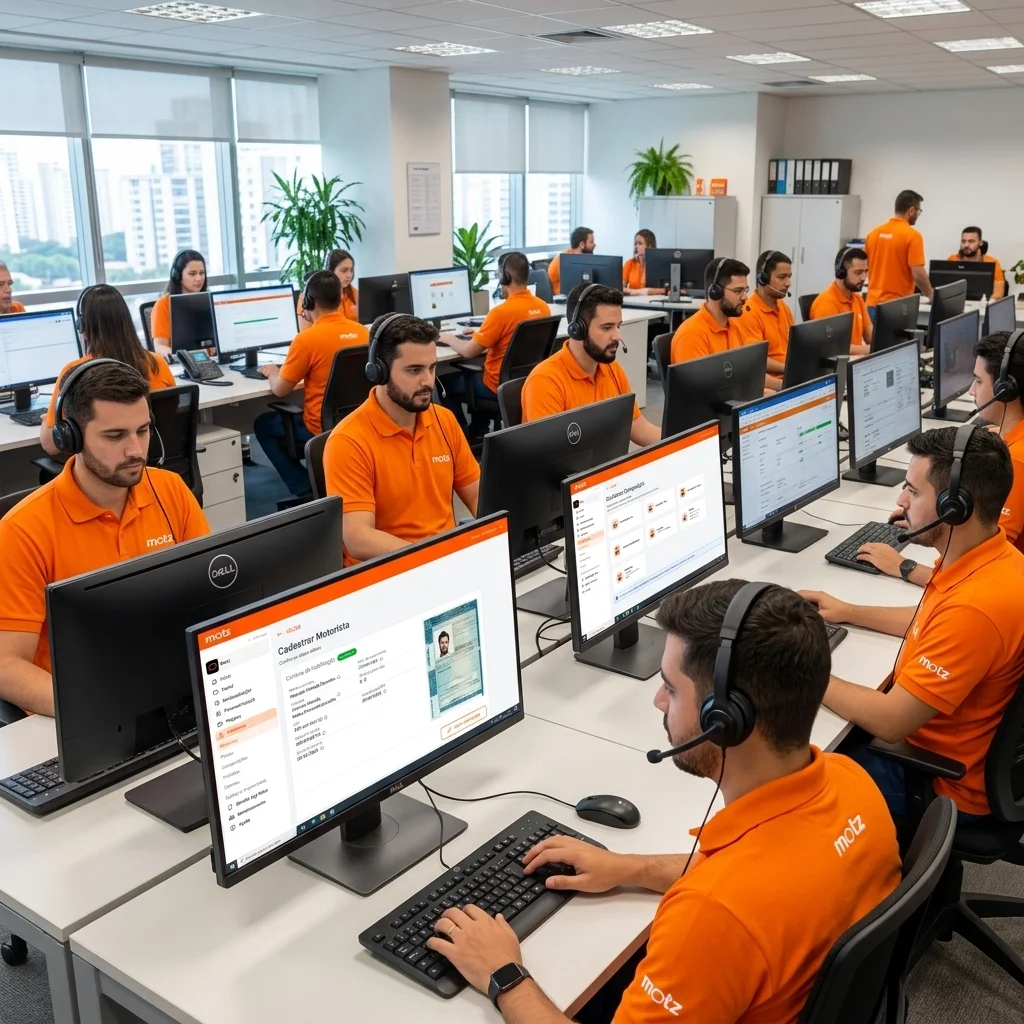
Motz Support Team
Back-office support without taking over the driver’s device
Onboarding challenges also impacted customer support operations. When drivers needed assistance, support agents often had to access their physical devices to complete registration, which created operational inefficiencies and increased privacy concerns under Brazil's LGPD. Consequently, many registrations were delayed or not completed.
Solution: The Operator Portal allows support staff to remotely review, verify and complete the registration process with drivers. By eliminating the need for physical access to drivers' devices, the platform has streamlined support operations and reduced the number of abandoned registrations.
Operational Impact: Support operations transitioned into a highly scalable, low-latency remote intervention layer.
Production Telemetry: Back-office performance metrics confirmed the portal successfully orchestrates assisted journeys for over 5k users monthly with zero transactional degradation.
Optimizing for Scale: The Two-Phase Registration
To scale operator throughput and compress average handle time, we restructured the vehicle validation lifecycle into a prioritized, multi-tiered sequencing model that forces automated data ingestion layers to execute before manual fallbacks trigger.

Final Portal Flow — a single, clear path with intelligent automated fallbacks
07 — Usability Testing
In-person field testing at CD Osasco
We conducted unmoderated usability testing with two groups of users: truck drivers using the mobile app, and support agents using the Operator Portal. The sessions confirmed that both were intuitive and effective, with particular praise for drivers who were able to complete the registration process independently, even while handling their freight documents in a busy warehouse environment. The result was a 100% task success rate.
without help

User research trip — The team gathered in front of the Votorantim Cimentos Osasco unit for a day of field interviews.
08 — Impact & Results
Operational efficiency at onboarding scale
- → −30% Time-to-Onboard: Accelerated the end-to-end mobile registration lifecycle through progressive data fetching.
- → −25% Support Ticket Volume: Slashed input-related error queries and administrative overhead for customer operations.
- → Self-Service Autonomy: Empowered truck drivers to complete complex compliance pipelines with zero operational intervention.
- → +15% MAU Growth: Expanded Monthly Active Users within the initial 90-day post-launch window by eliminating top-of-funnel friction.
- → 100% Data Integrity: Achieved zero cross-system entity duplication between Motz and Votorantim legacy frameworks.
Both the registration portal and the truck driver app are powered by the integration of third-party data sources and real-time OCR validation. By embedding automated identity and document verification in the onboarding process, a previously manual, compliance-heavy workflow has been transformed into a faster, self-service experience. Consequently, drivers can register more easily, while the platform reduces operational overheads and supports marketplace growth.
MORE
PROJECTS
Pulse Machine
2013 · Interactive Experience

Motz Freight Cards
2026 · Motz Transportes