NEURORAD.AI
High-precision AI for COVID-19 diagnosis, deployed at Hospital Oswaldo Cruz to reduce diagnostic uncertainty and speed up clinical analysis.
01 — Challenge
Healthcare under pressure.
During the pandemic, Oswaldo Cruz Hospital faced a surge of suspected COVID-19 cases. Radiologists needed to review X-rays and CT scans quickly, without losing accuracy when every minute affected patient care and infection control.
The challenge: combine machine learning speed with physician judgment in a diagnostic support tool that fit the hospital workflow instead of disrupting it.
02 — Research & Discovery
Discovery built around physicians.
I conducted qualitative interviews with physicians from different specialties to understand their workflows, pain points, and needs in high-pressure clinical routines.
→ Audience: Physicians from diverse specialties at Oswaldo Cruz Hospital.
→ Approach: Structured scripts focusing on clinical detection and operational bottlenecks.
→ Objective: Map the diagnostic journey and how AI could complement human expertise under high mental effort.
Five Key Insights That Shaped Design
Insight: Physicians spend long shifts in low-light rooms analyzing exams on bright screens, causing extreme eye strain.
Design Impact: Dark Mode as operational standard — reducing aggressive contrast and increasing comfort for prolonged analysis.
Insight: Patients already underwent detailed triage; repeating questions generated friction and lost precious time.
Design Impact: Integration via Protocol ID — data fetched automatically, eliminating redundancy and accelerating decisions.
Insight: Physicians struggled to locate diagnoses in extensive lists due to generic nomenclature.
Design Impact: Reorganization of tables with precise medical terminology and advanced search filters for efficiency.
Insight: AI cannot be a "black box" — physicians need to record observations about nuances of each case.
Design Impact: Lightweight annotation system + probability indicators for clinical validation by the physician.
Insight: Pneumonia associated with COVID-19 has distinct radiological patterns neglected under stress.
Design Impact: Interface optimized to highlight critical findings — serving as a "second pair of eyes" that increases diagnostic precision.
03 — Strategic Design Decisions
Designed for frontline diagnosis.
The interface focused on three practical outcomes: reduce mental effort, lower eye strain, and make AI confidence understandable enough for physicians to trust and challenge it.
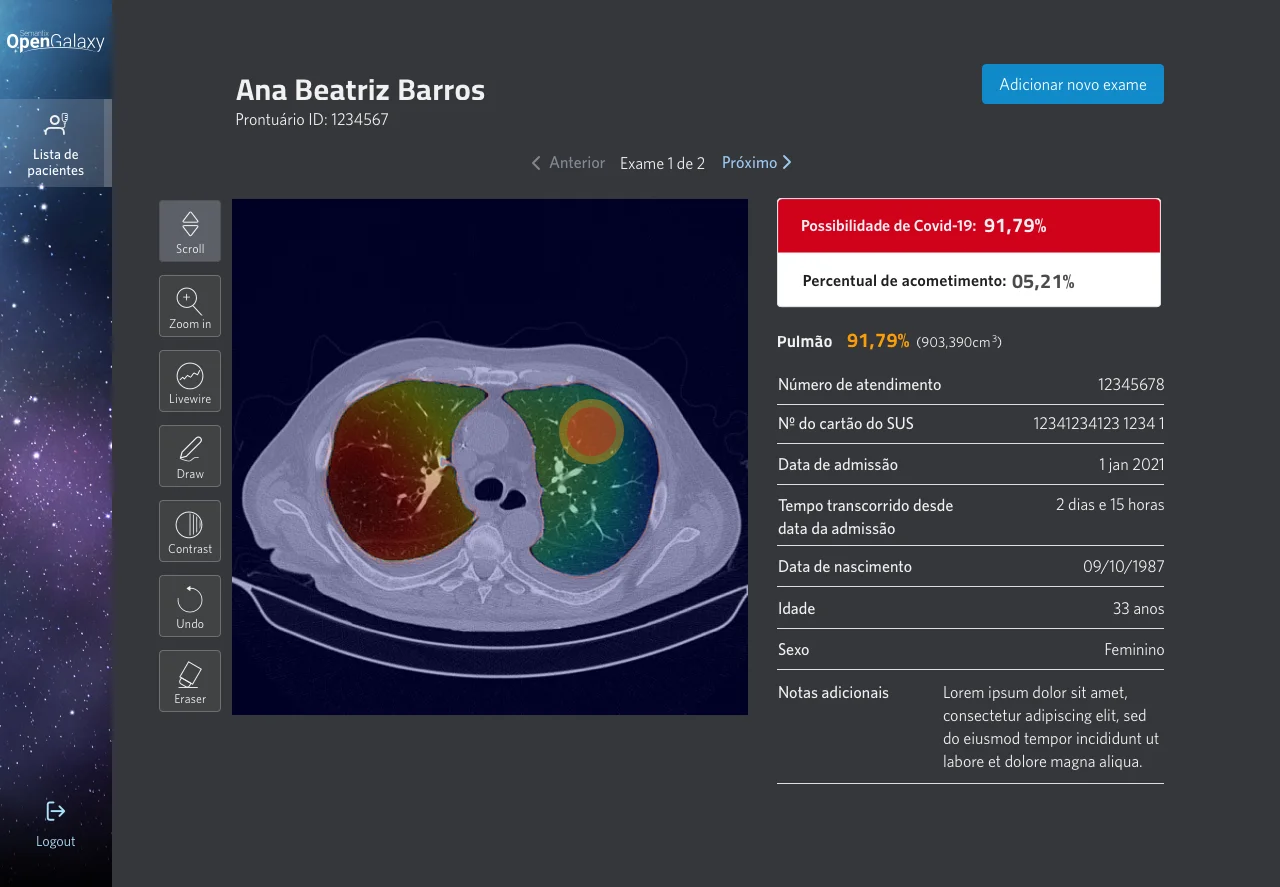
AI High-Confidence COVID-19 Detection
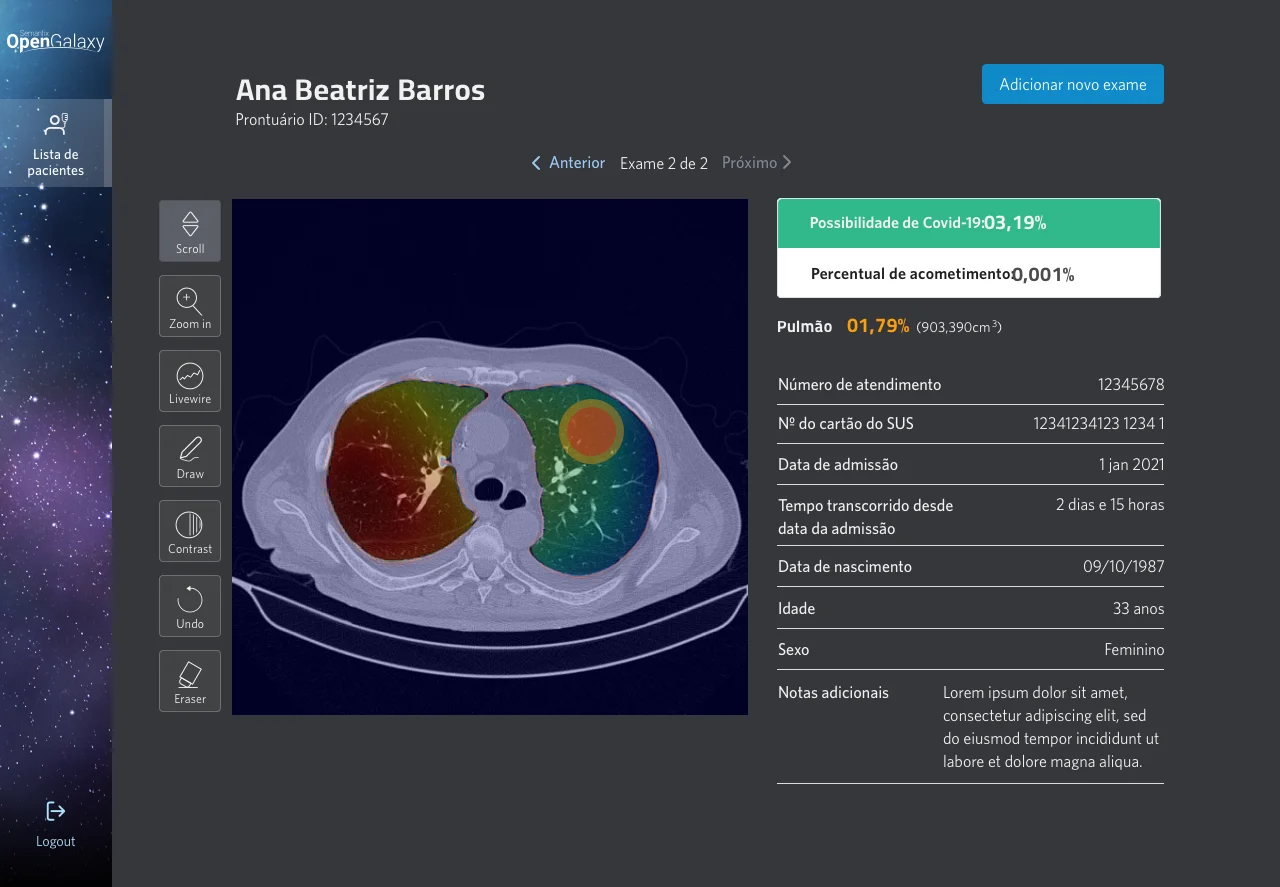
Negative Diagnosis with Confidence Level
Dark Mode as Operational Standard.
The Problem: Physicians work hours in dark rooms analyzing exams on high-brightness screens, resulting in extreme eye fatigue and loss of image detail sensitivity.
The Solution: Implemented low-luminance interface as default (Dark Mode) to reduce aggressive contrast between physical environment and screen.
Impact: Reduced eye strain and increased comfort for prolonged analysis of complex radiological studies.
Lightweight Annotation System.
The Problem: Automated diagnoses generate doubts if physicians cannot record nuances or observations specific to each case.
The Solution: Developed lightweight annotation system where physicians insert quick notes linked to patient Protocol ID.
Impact: Greater precision in patient history and facilitation of information exchange between medical shifts — highly well-received in usability tests.
Intelligent Search & Filtering.
The Problem: Physicians faced critical difficulties locating specific diagnoses in extensive search results due to visual overload and imprecise terminology.
The Solution: Reorganized table information architecture using precise medical terminology and implemented advanced search with filters by status and severity.
Impact: Reduced navigation time and real increase in team productivity managing COVID-19 cases — search time decreased from 90 to 54 seconds (40% improvement).
Confidence Score Visualization.
The Challenge: Binary AI response (Yes/No) generated physician skepticism — they felt disconnected from machine reasoning.
The Solution: Implemented clear Confidence Score visualization (COVID-19 probability). Instead of black-box, interface presented algorithm certainty level and visually highlighted image areas motivating the insight.
Impact: Enabled physicians to use AI as "second pair of eyes" to validate their judgment, increasing confidence in asymptomatic or early-stage cases.
Systemic Integration via Protocol ID.
The Challenge: Ensuring data consistency between the initial triage and the NeuroRad system. Manual synchronization was prone to information mismatch and incongruencies, creating clinical risks and slowing down the diagnostic flow.
The Solution: Designed direct integration with hospital systems through the Medical Protocol ID. Entering a unique code automatically fetched and synchronized triage data, previous exams, and patient history.
Impact: Eliminated data incongruency and ensured 100% information integrity across platforms. The interface shifted from a disconnected tool to an integrated clinical facilitator.
04 — Usability Testing & Iteration
Validated in high-pressure workflows.
I tested the interface with five physicians from Oswaldo Cruz Hospital across six diagnostic scenarios that simulated real clinical pressure.
“There are two key factors. One is time, which is critical for treating the patient. The other is the level of detail provided by a tool like Neurorad. For instance, we can assess the degree to which a patient’s lungs have been impacted by the virus.”
Kenneth Almeida, Hospital Oswaldo Cruz Executive Director
Six Critical Scenarios
- 1. Authentication: Secure system access with medical credentials
- 2. Security: Password recovery in ambulatory environment
- 3. Data Integration: Insert Protocol ID and link patient diagnoses
- 4. Information Recovery: Search for specific diagnoses in history
- 5. Documentation: Insert contextual clinical notes on diagnoses
- 6. Decision-Making: Interpret AI probability data to confirm COVID-19 cases
The Design Iteration.
As UX Lead, I led the restructuring of the system's complex information architecture.
→ Taxonomic Refinement: Replaced generic terms with standardized medical nomenclature
→ Data Architecture: Reorganized table elements to prioritize clinically critical information
→ Advanced Search: Implemented filters for rapid case segmentation by severity and date
Search Time Reduction: New design achieved a 40% improvement in task time, significantly accelerating the diagnostic workflow.
Workflow Impact: Physicians easily found the information they needed, resulting in efficient navigation and an immediate increase in clinical productivity.
User Validation: Physicians validated the intuitiveness of the new record management system, emphasizing its efficiency in handling complex cases.
05 — Validation Metrics & Confidence
Clinical validation and trust.
Validation focused on whether physicians could use the AI as a reliable second pair of eyes during frontline diagnosis.
The primary indicator was Diagnostic Accuracy. During the pandemic, the AI model achieved 80% superior precision compared to manual physician analysis at Oswaldo Cruz Hospital for suspected COVID-19 cases.
Validation was anchored in the tool's immediate utility: providing clear data that empowered physicians to make faster, more confident decisions in critical care scenarios.
Qualitative Evidence: Physicians appreciated the tool's ability to provide COVID probability insights (Likelihood), directly supporting decision-making processes.
User Satisfaction: Professionals expressed explicit satisfaction with the tool's potential to increase diagnostic precision in case management.
Sampling: 5 physician participants
Scope: 6 critical scenarios simulating real clinical routines
Practical Result: The search design iteration achieved a 40% gain in task efficiency, yielding real productivity gains and increasing physician confidence in the system's clinical utility.
06 — Impact & Results
Impact and results.
- → +80% Diagnostic Accuracy — Superior to manual physician analysis in COVID-19 detection
- → 40% Search Efficiency Gain - Significantly faster diagnosis lookup through optimized IA.
- → 5 Physicians Validated — Real clinical environment testing with positive feedback
- → High Accessibility Standards - Optimized for low-light clinical environments to reduce eye strain.
NeuroRad.ai worked because the design translated complex model output into decisions physicians could understand, verify, and act on under pressure.
06.1 — NeuroRad in Action
MVP and media proof.
Real-world demonstrations of the NeuroRad.ai MVP and international media coverage highlighting its clinical impact during the pandemic response.
Live MVP
Demonstration
This video demonstrates real-time performance including patient data integration via Protocol ID, AI-powered analysis, confidence score visualization, and physician validation.
Key moments: Protocol ID integration → Automatic data retrieval → Confidence score display → Physician annotation workflow
National
Media Coverage
CNN coverage featuring interviews with physicians at Oswaldo Cruz Hospital discussing NeuroRad.ai's impact on their diagnostic workflows. The segment highlights how NeuroRad.ai enabled clinicians to make faster, more confident decisions during the global health crisis.
Focus areas: Physician testimonials → Clinical impact → Pandemic response → Design philosophy
07 — Learnings & Reflection
What NeuroRad.ai taught me.
Leading NeuroRad.ai's design transformed my approach to complex, high-stakes projects. These are the insights I carry forward:
Confidence in the system drives adoption more than raw algorithmic performance. Even if a model achieves 99% accuracy, it is only as strong as the user's trust in how data is presented. In the field of healthcare UX, my role is to make technical data more human-friendly, ensuring that AI logic is transparent and actionable for physicians.
Physicians operate under rigid protocols. During the pandemic, the challenge wasn't changing their behaviour, but respecting their reality. I designed around existing workflows, only adding technology where it would create immediate value.
Dark mode and the table hierarchy weren't aesthetic choices; they were based on real working conditions, such as lighting and physician fatigue. Design works better when it responds to context rather than trends.
A 40% reduction in time meaningfully changed daily workflows. Across hundreds of consultations, this efficiency adds up to a significant amount of regained clinical time.
Future Potential
COVID-19 Pneumonia: NeuroRad.ai proved the concept during the pandemic crisis. A single specialty solved with human-centered design, validation protocols, and iterative improvement.
Beyond Pneumonia: The patterns and validation methods developed for pneumonia can be applied to other areas. The same human-centred approach can be scaled up to include neurology, cardiology and other medical imaging domains.
NeuroRad.ai's success lay in its ability to translate complex data into something usable within the environment of hospital workflows during a global crisis.
MORE
PROJECTS
Ugong Live Commerce
2021 · Ugong B2B · Live Commerce

AirFight
2014 · Mobile App · Motion Capture